

How to measure the rate of moisture evaporation from textiles?
Summer's intense, scorching sun makes it the perfect time for travel. Some are drawn to mountain climbing, traversing rugged trails to enjoy the mountain breeze and the thrill of self-challenge; others prefer the beach, strolling on soft sand, listening to the waves, and savoring the cool seawater. However, the summer heat is ever-present, and even slight activity can leave you drenched in sweat. This sticky feeling can not only spoil the enjoyment of your trip but also cause discomfort. At this time, the moisture-wicking and quick-drying properties of clothing become especially important. Like an invisible guardian, it keeps us cool and comfortable during summer outings.
What is the moisture-wicking and quick-drying property of clothing?
The moisture-wicking and quick-drying property of clothing refers to its ability to quickly absorb sweat from the body and transfer it to the outer surface of the fabric for rapid evaporation, keeping the body dry and comfortable. Moisture-wicking and quick-drying clothing has been popular with sports enthusiasts since its introduction, but due to cost considerations, it was initially primarily worn by professional athletes. With technological advancements, continuously improving product functionality, and significant cost reductions, moisture-wicking and quick-drying clothing has become a widely popular functional product among consumers.
The measurement principle of textile moisture meters, including oven drying weight loss meters, is based on the moisture content of textiles. The instrument automatically calculates the moisture content of the textile as a percentage of the difference in sample mass before and after heating, expressed as the percentage of the original sample mass before heating. Simultaneously, textile moisture meters can also be used to measure the moisture regain of textile materials. The moisture regain of textile materials is expressed as a percentage of the difference between the sample's mass before drying and its mass after drying, divided by the mass before drying. Textile moisture regain is a parameter characterizing the water absorption capacity of textile materials and is an important quality indicator for textiles.
The Principle of Moisture-Wicking and Quick-Drying Fabrics
The essence of moisture-wicking and quick-drying fabrics is "rapid moisture wicking + efficient evaporation," which relies on the hydrophilicity of the fibers and the structural design of the fabric.
(1) Moisture Absorption Process (Water Absorption)
Hydrophilic Groups: The surface of moisture-wicking fibers (such as modified polyester and nylon) contains hydrophilic groups such as hydroxyl (-OH), amino (-NH₂), and carboxyl (-COOH), which can quickly absorb sweat through hydrogen bonds. Capillary Effect: Tiny pores between fibers form capillaries, utilizing the surface tension of the liquid to draw moisture away from the skin surface and diffuse it to the outer layer of the fabric.
(2) Quick-Drying Process (Water Evaporation)
Increasing Evaporation Area: Through irregularly shaped fibers (such as cross-shaped and Y-shaped) or three-dimensional weaving structures (such as mesh and honeycomb), moisture is evenly distributed and evaporation is accelerated. Hydrophobic Outer Layer Design: Some double-layer fabrics (such as Adidas Climacool®) have a hydrophilic inner layer for sweat absorption and a hydrophobic outer layer for moisture wicking, promoting the outward diffusion of moisture. (3) Analogical Understanding
Ordinary cotton T-shirts are like "sponges," absorbing sweat but locking the moisture inside the fibers, resulting in slow evaporation; moisture-wicking and quick-drying fabrics are like "water-guiding nets," quickly guiding sweat to the surface for evaporation.
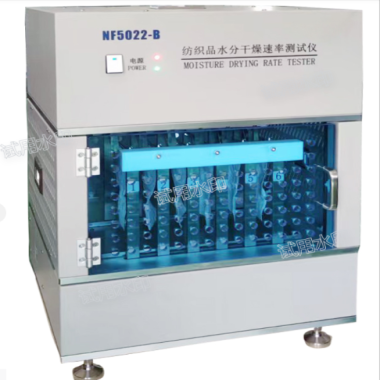
Tester Working Principle
The core working principle of the moisture evaporation rate tester is to use a heating device to heat the test sample, while simultaneously monitoring the ambient temperature and humidity, as well as the vapor pressure generated by moisture evaporation, in real time through temperature and humidity sensors. Through the collection and processing of this data, the instrument can accurately calculate the rate of moisture evaporation.
Tester Usage
The textile moisture meter is relatively simple to operate and has a wide range of applications, suitable for almost all industries that need to test the moisture content of materials. With the instrument at 0.000g, take 1-2g of textile material sample and place it in the sample tray, spread it evenly, and then tighten the anti-bulging net. Next, cover the heating chamber, select start, and begin heating and measurement. At the end of the test, the instrument automatically displays the moisture content and solid content of the sample, and can switch to displaying the textile's moisture regain parameter.
How to Maintain and Care for the Instrument
1. Instrument Placement:
Keep away from light; maintain an indoor temperature of 5°C~35°C. Do not install the instrument in environments with high humidity or high power fluctuations. Do not operate in environments with corrosive gases.
2. Replacement of Silica Gel:
Prolonged use of silica gel gaskets at the sample injection port can cause the pinhole to not shrink, which will affect the determination of atmospheric moisture. Replace it promptly.
3. Replacement of Drying Silica Gel:
When the silica gel in the drying tube changes from blue to light blue, replace it with new silica gel. Do not load silica gel powder during replacement; otherwise, the electrolytic cell will not be able to vent, and electrolysis should be terminated.
4. Maintenance of the Ground Joint of the Electrolytic Cell:
Rotate the ground joint of the electrolytic cell every 7-8 days. When it cannot be rotated easily, reapply a thin layer of vacuum grease and reload. Otherwise, it will be difficult to disassemble after prolonged use.
Note: If the electrode cannot be removed, do not pull it out forcefully. The correct method is to immerse the entire electrolytic cell in warm water for 24-48 hours. 5. Cleaning the Electrolytic Cell:
Wash the electrolytic cell bottle, drying tube, and sealing plug with water. After cleaning, dry in an oven at approximately 80°C, then allow to cool naturally. The electrolytic electrodes cannot be washed with water; they can be cleaned with anhydrous ethanol and then dried with a fan.
Purpose of the Testing Instruments
Testing instruments used to evaluate the moisture absorption and quick-drying properties of textiles primarily aim to quantitatively assess the moisture absorption, diffusion, and drying speed of textiles by simulating human sweating and external environmental conditions. These instruments can accurately measure the ability of textiles to absorb moisture within a certain time, the diffusion rate of moisture within the fabric, and the drying rate on the fabric surface, thus comprehensively reflecting the moisture absorption and quick-drying performance of textiles.
Professional textile moisture absorption and quick-drying testers are the core support for unlocking comfortable summer wear. Based on scientific principles, they provide objective evidence for the research, development, production, and quality control of functional clothing by accurately quantifying the moisture absorption capacity, diffusion rate, and drying efficiency of fabrics—making "moisture absorption and quick-drying" no longer a vague slogan, but a verifiable practical performance. From simple operating procedures to meticulous maintenance, these instruments use rigorous testing logic to screen out high-quality fabrics that can truly resist the stickiness of summer. This not only strengthens the product quality defense line for enterprises but also gives consumers more confidence when choosing travel gear. It is thanks to the powerful support of these professional testing instruments that we can confidently embrace the sun and breeze on summer hikes and beaches, completely eliminating the discomfort caused by sweat and ensuring every trip is cool, comfortable, and worry-free.