

What are the four common methods for testing for pilling?
In the textile industry, the pilling and fuzzing properties of fabrics are one of the important indicators for measuring their quality and service life. To ensure that textiles have good anti-pilling and fuzzing properties during wear and use, manufacturers and testing institutions often use a variety of testing methods for evaluation. Among them, the four conventional pilling test methods of Circular Locus Pilling Testers—circular trajectory method, Martindale method, pilling box method, and random tumbling method—are widely used in the industry due to their unique testing principles and applicable scope.
I. Circular Track Method
The circular track method, also known as GB/T 4802.1—2008. is a test method that simulates pilling and fuzzing of fabrics under specific pressure when rubbed against a nylon brush or fabric abrasive. This method induces pilling and fuzzing on the sample surface through a specified number of friction cycles and pressures, and then visually assesses the results under specific lighting conditions. The circular track method offers a relatively fast testing speed and effectively simulates pilling caused by hooking and friction during actual wear, making it particularly suitable for testing woven apparel fabrics and knitted fabrics such as sweatshirts and T-shirts.
During the test, the sample is fixed on the testing instrument and rubbed along a preset circular track. By adjusting the number of friction cycles, pressure, and type of abrasive, pilling under different usage conditions can be simulated. After the test, evaluators grade the sample based on the degree of pilling and fuzzing, thus assessing the fabric's anti-pilling and fuzzing performance.
The circular track method pilling and fuzzing tester is an essential tool for quality inspection in the textile industry, and its importance is self-evident. This testing instrument plays a crucial role in the production, processing, and finished product inspection of textiles.
With continuous technological advancements, the circular trajectory method pilling tester is constantly being updated. Newer testers not only offer higher testing accuracy but are also easier and faster to operate. By simulating the friction and compression processes experienced by textiles in actual use, the tester can accurately assess the pilling performance of textiles, thus providing strong data support for textile quality control.
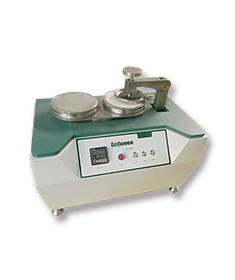
Principle:
Following prescribed methods and test parameters, a nylon brush and abrasive, or abrasive alone, are used to rub and pill the fabric. Then, under specified lighting conditions, a standard sample is compared after pilling to determine the pilling level.
During the test, the circular trajectory method pilling tester moves along a predetermined trajectory, causing the textile to pill under a certain frictional force. After the test, testers can comprehensively evaluate the abrasion resistance and anti-pilling performance of the textile by observing the pilling condition on the test sample surface and comparing data such as weight changes before and after the test.
Application Areas
Furthermore, the circular trajectory method pilling tester has a wide range of applications. Whether it's clothing, home textiles, carpets, or other textiles, or special textiles such as automotive interiors and industrial fabrics, this tester can be used to test pilling performance. This not only helps improve the quality of textiles but also helps meet consumer demands for comfort and durability.
II. Martindale Method
The Martindale method, also known as GB/T 4802.2—2008 "Modified Martindale Method," is a test method that uses a circular specimen in a sample holder to rub against an abrasive on a grinding table. The specimen can rotate freely about a central axis perpendicular to its plane, rubbing along a Lissajous figure trajectory. This method is suitable for testing large-area fabrics such as bedding, and can effectively reflect the pilling and fuzzing of fabrics during long-term use.
During the test, the specimen is fixed in the holder and rubbed against an abrasive (usually the same fabric or wool abrasive) on the grinding table. By adjusting parameters such as load mass, abrasive type, and number of friction cycles, different usage conditions can be simulated. After the test, the degree of pilling and fuzzing of the specimen is also evaluated visually.
Test Principle:
Under a specified pressure, a circular specimen rubs against a fabric with the same fabric or wool abrasive along a Lissajous figure trajectory. The specimen can rotate freely about a central axis perpendicular to its plane. After a specified friction stage, the pilling or fuzzing grade of the sample is assessed visually.
Scope of Application: This general method is applicable to textiles, interior decorations, carpets, and even leather. It is a standard tool for quality control in the textile industry.
III. Pilling Box Method
The pilling box method, also known as GB/T 4802.3—2008. is a method for testing pilling and fuzzing performance by randomly tumbling the sample within a cork-lined wooden box at a constant rotation speed. This method is particularly suitable for testing woolen textiles, simulating the friction and pilling conditions of fabrics during washing and wearing.
During the test, the sample is mounted on a polyurethane tube and placed inside a cork-lined wooden box. As the box rotates at a constant speed, the sample randomly tumbles within the box, rubbing against the cork lining. After a specified number of tumbling cycles, the sample is removed for visual assessment. The pilling box method can comprehensively reflect the pilling and fuzzing performance of fabrics in different directions.
Test Principle:
The sample mounted on a polyurethane tube is randomly tumbled at a constant speed in a cork-lined wooden box. After a specified number of tumbling cycles, its pilling and/or fuzzing properties are evaluated visually.
Notes:
Pay attention to the friction properties of the rubber-cork lining and test the coefficient of friction periodically. When using a new rubber-cork lining, generally perform a no-load run first.
The convex surfaces at both ends of the sample tube (polyurethane plastic tube) should be flat and smooth.
When using adhesive tape, ensure the tape is flat and smooth.
IV. Random Tumbling Method
While not directly corresponding to a specific national standard, the random tumbling method is based on a principle similar to the pilling box method. It simulates the friction conditions of actual use by randomly tumbling the sample within the testing device. This method offers greater randomness and flexibility during testing, and can more comprehensively reflect the pilling and fuzzing performance of fabrics.
The testing device typically includes a container lined with a soft liner and a drive mechanism. The sample is placed in the container and moves and rubs randomly as the container tumbles. After a certain amount of time or number of tumbling cycles, the sample is removed for evaluation. The random tumbling method is particularly suitable for testing fabrics that require simulating complex usage environments.
Test Principle:
The random tumbling pilling tester can detect the pilling performance of fabrics. In a separate stainless steel sample testing chamber, under the rotation of stainless steel blades, the fabric under test continuously and randomly rubs against the cork liner. The testing time is controlled by a timer and an audio alarm. Compressed air can also be injected into the testing chamber to enhance the tumbling and friction effects.
Scope of Application: Suitable for various clothing, bedding, and other everyday wear and home textiles, especially for evaluating pilling performance in the apparel industry.
The four conventional pilling test methods of the fabric pilling tester each have their own characteristics and are applicable to different types of fabrics and different testing needs. The circular trajectory method, with its fast testing speed and good simulation effect, plays an important role in the testing of woven and knitted apparel fabrics; the Martindale method, with its wide applicability and stable test results, is the first choice for testing bedding fabrics; the pilling box method and the random tumbling method, with their unique testing principles and flexibility, play an important role in the testing of sweaters and other fabrics used in complex environments.