

What is Face Mask Fabric And Non-Woven Mask Breathing Respiratory Resistance Tester?
As face masks have become an essential protective item in people's daily lives, their quality has become a hot topic. The quality of a face mask can be measured by various test indicators. Respiratory resistance is one of the core performance indicators of a face mask: excessive resistance can lead to difficulty breathing for the wearer (especially during prolonged use), while insufficient resistance may indicate that the filter material is too permeable and the filtration efficiency is insufficient. Therefore, testing must strictly follow standards to balance "protection" and "wearing comfort."
Face masks work by covering the mouth, nose, and chin, creating a tight seal with the face. When a person inhales, air is forced through the mask, filtering out harmful substances and providing protection. The protective principle of a face mask is based on its filtration efficiency of harmful substances. The higher the filtration efficiency of harmful substances, the better the air purification, the healthier the air inhaled, and the better the protective effect of the mask. In addition to achieving a certain level of protection, wearing comfort is also an important factor to consider. The breathability of the mask is one of the main factors affecting wearing comfort. If the breathability is poor, consumers will experience difficulty breathing, and improper use may lead to serious consequences.
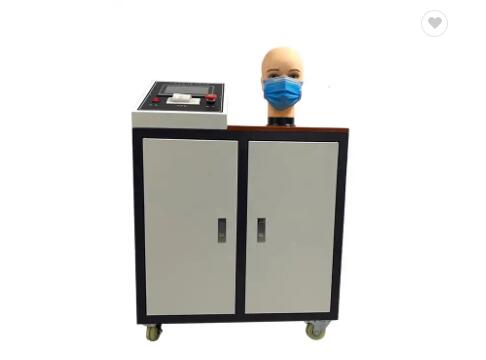
The face mask respiratory resistance testeris suitable for measuring the inspiratory and expiratory resistance of respirators and face masks under specified conditions, and is used by national labor protection product inspection agencies and manufacturers for relevant testing and inspection of ordinary face mask products. The instrument uses new technology, features fully automatic testing without an external air source, and requires no additional manual adjustment during testing. After attaching the test sample, simply press the test button for 10-20 seconds to simultaneously detect inspiratory and expiratory resistance and display the test results. The instrument's internal sensor is a high-precision digital sensor from SMI (accuracy 1%), ensuring the accuracy of the test results. The instrument is equipped with a thermal printer to print test results.
What factors affect the breathability of face masks?
1. Mask breathability is related to the mask's structure.
Mask material structure: Non-woven fabrics generally have a single-fiber network structure, offering the best breathability and being the most widely used. For woven fabrics, the gaps between the yarns are closely related to the fabric's breathability; the larger the gaps, the better the breathability. For example, gauze masks with larger gaps are more breathable than those made of tightly woven fabrics like poplin or twill. Generally, knitted masks are more breathable than woven masks.
Number of layers in the mask material: Generally, masks with more layers have relatively poorer breathability. For example, adding one or more layers of non-woven fabric with particle filtration capabilities between two layers of spunbond non-woven fabric or two layers of knitted or woven fabric will significantly reduce breathability.
2. Mask breathability is related to wearing and use.
When a mask does not fit tightly to the face, there will be gaps. The airflow resistance through these gaps is far less than that of the filter material, and the airflow will preferentially pass through the areas with less air resistance. In this case, the wearer feels that the mask is breathable, but the protective effect of the mask is greatly reduced. Therefore, when wearing a mask, it is important to choose a mask that fits your face shape and to use the nose clip and straps to ensure a tight fit between the mask and the face. Only then can good protection be achieved.
3. Mask breathability is related to filtration efficiency.
The breathability of a mask is somewhat correlated with its filtration efficiency. When a mask has poor breathability, it blocks external substances from entering the mask, increasing filtration efficiency, but reducing wearing comfort.
In short, the breathability of a mask is related to its structural design, as well as the wearer's use and individual face shape. Therefore, choosing a mask that fits your face shape and offers both good protection and breathability is very important.
Working Principle
The core function of the mask respiratory resistance tester is to simulate the human breathing process. By detecting the pressure difference across the mask under specified airflow conditions, it measures the inspiratory and expiratory resistance. The specific principle can be broken down into the following steps:
1. Simulated Respiratory Airflow Output
The instrument uses a built-in airflow control system to output a stable airflow according to the test standard requirements. The airflow range covers 0-200 L/min, and the flow accuracy must be better than ±2%, ensuring that the simulated breathing state conforms to actual use scenarios.
2. Mask Wearing and Fixing
The mask to be tested is fixed on a standard head model according to the actual wearing method, and the mask is secured to prevent loosening during the test, which could affect the final test results.
3. Pressure Difference Detection
During the airflow through the mask, the instrument detects the pressure difference across both sides of the mask using a high-precision differential pressure sensor.
4. Data Recording and Output
During the test, the instrument records data such as flow rate and pressure difference in real time, displays the results on a touchscreen, and can store the data in the built-in system. A report can also be printed using a thermal printer for analysis by testing personnel to determine whether the mask resistance meets the standards.
Testing Method
Check the airtightness and working condition of the testing device. Adjust the airflow to the specified conditions and set the system resistance of the testing device to 0.
Place the test sample on a matching head form, adjust the position of the mask and the tightness of the head strap to ensure a tight seal between the mask and the test head form. Then adjust the airflow to the specified conditions, measure and record the inhalation/exhalation resistance. During the measurement process, take appropriate measures to prevent the sample from adhering to the respiratory tube opening.
Testing Cycle and Sample Quantity
Number of test samples: 3-6.
Testing cycle: Generally 1-6 working days.
Note: Pre-treatment includes temperature pre-treatment and simulated wearing.
Please ensure that the submitted samples are properly packaged to ensure sterile sampling and packaging.
Application Scenarios
Mask and respiratory protective equipment manufacturers: Used for raw material inspection, production process control, and finished product outgoing inspection.
Third-party testing institutions: Providing authoritative certification and testing reports for products.
Quality and technical supervision departments: Used for market sampling and supervising product quality.
Research and laboratories: Used for performance and structural research of new protective materials.
As an important protective product for safeguarding public health, the quality and performance of masks are crucial to everyone's personal safety and comfort. The mask respiratory resistance tester, with its precise testing capabilities, convenient operation process, and wide range of application scenarios, provides solid technical support for the strict control of mask quality. From raw material inspection by manufacturers to authoritative certification by third-party institutions, from market sampling by quality and technical supervision departments to research on new materials in scientific laboratories, it plays an indispensable role, helping the industry continuously improve mask quality and building a reliable line of defense for people's healthy breathing.