

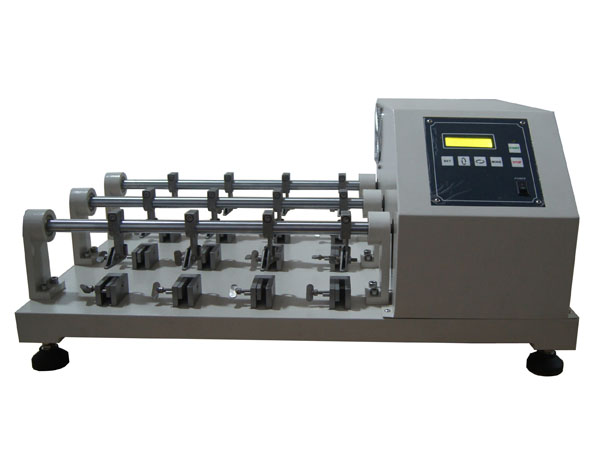
Bally Type Flexometer,DIN 53.351
In the fields of materials science and quality inspection, evaluating the durability of materials under repetitive bending is of paramount importance. For flexible materials such as leather, synthetic leather, textiles, and thin films, products are subjected to constant folding, twisting, and deformation during use. This repetitive mechanical stress can lead to cracking, peeling, or structural failure, ultimately compromising the product's lifespan and performance. Consequently, a standardized testing method is required to simulate the bending fatigue that occurs during prolonged usage. The Bally Type Flexometer is a specialized professional testing instrument used specifically to evaluate the resistance to bending fatigue in these materials.
Definition
The Bally Type Flexometer (also known as a Bally Flexing Tester, Flex Resistance Tester, or Flexometer) is an experimental device used to determine the performance of materials under repeated flexing actions. Its primary function is to simulate the repetitive folding and buckling experienced by materials during actual use and to evaluate their flex resistance or durability over a specific number of cycles.
This tester is particularly suitable for testing the flexural endurance of leather and its surface finishes, synthetic leathers, and coated fabrics. Testing can be conducted under dry or wet conditions to provide a comprehensive assessment of durability in real-world environments.
Testing Principle
The testing principle of the Bally Type Flexometer relies on mechanical devices to repeatedly fold the specimen at a specified angle and frequency to simulate actual wear. According to international standards, a specimen is first folded and then secured between an upper and a lower clamp. Once the machine is started, the upper clamp reciprocates at a fixed angle and speed, causing the specimen to buckle repeatedly.
Typically, the specimen is folded longitudinally with the grain (outer surface) facing outward before being fixed. The upper clamp reciprocates through a specified angle (usually $22.5^\circ \pm 0.5^\circ$) at a standard frequency (e.g., $100 \pm 5$ cycles per minute). By observing the specimen for cracks, delamination, or other forms of failure, the material's bending fatigue durability can be evaluated qualitatively or quantitatively. The number of cycles completed when a certain level of damage is reached is recorded as the primary durability index.
Applicable Materials and Test Conditions
The Bally Type Flexometer is primarily utilized for:
Leather Materials: Especially leather used in footwear, apparel, gloves, and luggage.
Synthetic Leather and Films: Flexible materials generally not exceeding 3 mm in thickness, including coated fabrics and artificial leather.
Other Flexible Materials: Certain textiles and composite materials.
Test conditions are set to dry or wet based on specific standard requirements. Wet testing usually involves pre-soaking or pre-treating the specimen to simulate performance in humid or rainy environments.
Major Standards and Specifications
Testing is conducted in accordance with several international and industry standards:
ISO 5402-1: Determination of flex resistance for flexible leather.
ISO 32100: Determination of flex resistance for rubber- or plastics-coated fabrics.
ASTM D6182: Standard test method for flexibility and adhesion of finish on leather.
BS 3144: Methods of sampling and physical testing of leather.
JIS K6545: Testing method for checking the endurance of light leathers against flexing.
EN ISO 20344: Personal protective equipment (footwear) test methods.
SATRA TM55: Flexing resistance of upper materials.
Equipment Construction and Technical Parameters
The Bally Type Flexometer typically consists of the following components:
Clamping System: Upper and lower clamps designed to hold the specimen securely under the correct tension.
Drive Mechanism: Powered by a motor and mechanical transmission to achieve precise reciprocating motion.
Control System: Features digital counters, LCD displays, and control panels to preset cycle counts and enable automatic shut-off.
Frame Structure: Often constructed from corrosion-resistant steel or stainless steel to ensure long-term stability.
Common Technical Parameters:
Specimen Size: Generally $70 \times 45$ mm.
Flexing Angle: $22.5^\circ \pm 0.5^\circ$.
Flexing Frequency: $100 \pm 5$ cpm (cycles per minute).
Counter Range: 0 to 999.999 cycles.
Power Supply: Single-phase AC 220V, 50/60 Hz.
Workstations: Available in configurations of 4. 6. 12. or 24 stations for simultaneous testing.
Operating Procedure
Preparation: Cut the specimen to standard dimensions and perform required pre-treatment (dry/wet).
Mounting: Fold the specimen with the test surface facing out and secure it between the clamps.
Parameter Setting: Set the target number of cycles and frequency on the control panel.
Execution: Start the tester to begin the reciprocating motion.
Observation: Monitor the specimen surface for cracks or delamination periodically or at the end of the test.
Results Evaluation: Record the number of cycles at which failure occurs to determine the durability index.
Application and Significance
Footwear and Tanning Industry: Evaluating the durability of shoe uppers during the walking motion.
Textile and Coating Inspection: Determining performance changes in fabrics and synthetic leathers after repeated deformation.
R&D and Quality Control: Providing scientific data for material development and formula optimization.
Certification: Meeting international standards for product safety and quality certification.
The Bally Type Flexometer is an essential tool in the field of material testing. By simulating the repetitive folding process and quantifying durability based on standardized metrics, it provides material engineers with reliable data. Whether for quality control in leather goods or the comparative analysis of new flexible materials, this instrument remains indispensable for ensuring product reliability and performance.