
Tel:+86-21-6780 0179
Fax:+44(0) 207 398 0999
Email:market@qinsun-lab.com

Glow Wire Test Apparatus
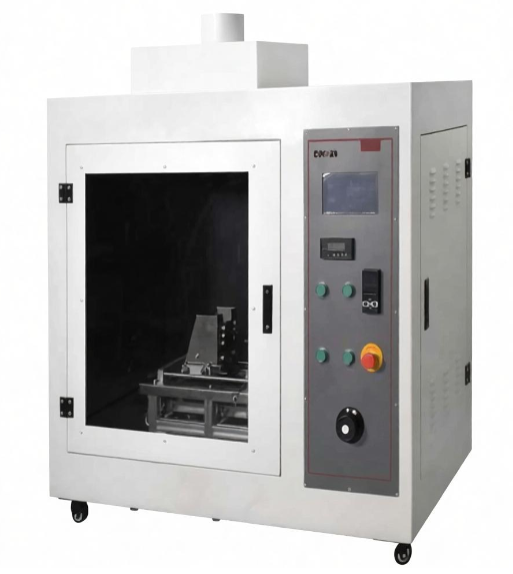
Glow-wire tester simulates thermal stress from heat sources to test circuit component flammability, widely used in electronics, appliances, etc. It predicts circuit safety, controls production, and verifies performance. The test applies short-term heat to samples, assessing fire risk by observing light-off states. It measures ignition hazards of materials by burning them at specified temps and pressures.
Application
Glow wire tester is suitable for lighting equipment, low-voltage electrical appliances, electrical instruments, and other electrical and electronic products and non-metallic materials and parts for household electrical appliances, such as: switch shell, relay socket. Wide range of applications. It can be applied to the production enterprises, quality inspection departments, institutions and research institutes and other institutions.
Instruction
The best method for testing electro technical products with regard to fire hazard is to duplicate exactly the conditions occurring in practice. In most instances, this is not possible. Accordingly, for practical reasons, the testing of l products with regard to fire hazard is best conducted by simulating as closely as possible the actual effects occurring in practice.
Parts of insulating material or other material which are liable to propagate flames inside the equipment may be ignited by glowing wires or glowing elements.
Under certain conditions (for example, a fault current flowing through a wire, overloading of components, and bad connections), certain elements may attain a temperature such that they will ignite parts in their vicinity.
Standards
IEC 60695-2-10 Fire hazard testing for electric and electronic products—Part 2-10: Glowing/hot-wire based test methods—Glow-wire apparatus and common test procedure
IEC 60695-2-11 Fire hazard testing for electric and electronic products—Part 2-11: Glowing/hot-wire based test methods—Glow-wire flammability test method for end-products (GWEPT)
IEC 60695-2-12 Fire hazard testing for electric and electronic products―Part 2-12: Glowing/hot-wire based test methods―Glow-wire flammability index (GWFI) test method for materials
IEC 60695-2-13 Fire hazard testing for electric and electronic product―Part 2-13: Glowing/hot-wire based test methods―Glow-wire ignition temperature (GWIT) test method for materials
VDE 0471-2-13 Fire hazard testing - Part 2-13: Glowing/hot-wire based test methods
DIN EN 60695-2-13 Fire Hazard Testing.Parts 2-13: Glow Wire/Heating Wire Test Methods – Glow Wire Ignition Temperature (GWIT) Test Methods for Materials
GB/T 5169.10 Fire hazard testing for electric and electronic products—Part 10: Glowing/hot-wire based test methods—Glow-wire apparatus and common test procedure
GB/T 5169.11 Fire hazard testing for electric and electronic products—Part 11: Glowing/hot-wire based test methods—Glow-wire flammability test method for end-products (GWEPT)
GB/T 5169.12 Fire hazard testing for electric and electronic products―Part 12: Glowing/hot-wire based test methods―Glow-wire flammability index (GWFI) test method for materials
GB/T 5169.13 Fire hazard testing for electric and electronic product―Part 13: Glowing/hot-wire based test methods―Glow-wire ignition temperature (GWIT) test method for materials
Technical parameter
1.Heating temperature: 500-1000 or less continuous tunable range, temperature measurement accuracy of plus or minus 10
2.More than burning time: 0.1 999.9 s, plus or minus 0.1 s (adjustable time range)
3.Burning time: 0.1 999.9 s, automatic recording, pause manually
4.Residual flame time: 0.1 999.9 s, automatic recording, pause manually
5.Hot wire for sample pressure. Pressure limiting depth of 7 mm
6.Glow wire: nickel chromium (80%), chromium (20%), the size is made according to the rules.
7. Thermocouple: nickel chromium/nickel aluminum wire, k index
8. Auto off: sample after reaching prescribed burning time, automatically be off from the hot wire
9.Overall dimensions: width,deep,high (1120. 520.520) mm
Main performance characteristics
1. the use of suction relay to control the burning wire to burn the depth of the sample, and the instrument has adjustable function, while equipped with measuring gauge, with accurate and efficient features.
2. the instrument applies British imports thermocouple (4437951)that can accuratly control temperature . the device also Uses Omron relay, timer, Merlin Gerin leakage protector, red wave button and other famous brand to ensure long-term stable operation !
3. glowing wire contact with the measured items, the device continues to supply power, sample car returned after 2S cut off the current to ensure that the test accurately
4. equipped with mesh transfer sample fixture to facilitate the clamping of special-shaped and small test items.
5. lighting lamps with standard explosion-proof lamps, in line with safety standards
6. the use of wild air sealed fan to ensure that the box sealed. And the exhaust effect is strong!
7. the box with 1.2mm stainless steel box, nice!
FAQ
1. What is the purpose of a Glow Wire Tester?
The Glow Wire Tester is used to assess the fire hazard of electrical and electronic equipment, solid insulating materials, and other solid combustible materials by simulating thermal stress caused by overheated components.
2. What properties of materials can be evaluated by this test?
The tester evaluates ignition behavior, flammability, Glow Wire Ignition Temperature (GWIT), and Glow Wire Flammability Index (GWFI), which are critical indicators of fire safety performance.
3. Which industries commonly use the Glow Wire Tester?
It is widely used in the electrical and electronics industry, insulation material manufacturing, engineering plastics, automotive components, household appliances, construction materials, textiles, and packaging materials.
4. What temperature range does the tester support?
The glow wire temperature is continuously adjustable from 500°C to 1050°C, with a control accuracy of ±2°C, meeting the requirements of international standards.
5. How is test pressure and penetration depth ensured?
The tester applies a standard force of 0.95 ± 0.1 N and a controlled penetration depth of 7 mm ± 0.05 mm, using a precision limit adjustment system to ensure repeatability and compliance with standards.
