
Tel:+86-21-6780 0179
Fax:+44(0) 207 398 0999
Email:market@qinsun-lab.com
Button Impact Machine
Product Information
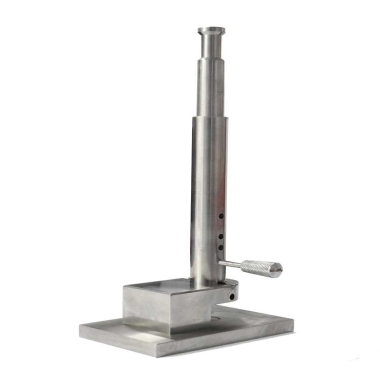
With the equipment the impact resistance of plastic sew-through flange buttons can be determined that a falling mass of 0.84kg (29.5oz) is released from a height of 67mm (2.625inch) or other heights as required. Cracking, chipping or breakage constitute failure.
Testing Standards
ASTM D5171:Test Method for Abrasion Resistance of Inks and Coatings (referenced for impact-related durability assessments).
Application
Button falling weight impact tester is used to determine the impact resistance of plastic sew-through flange buttons to a falling mass of 0.84kg (29.5oz), released from a height of 67mm (2.625 inches) or other heights as required. Evaluation Cracking, chipping and breakage, any of which constitutes damage. Test the remaining specimens.
Features
1. Ensure the vertical alignment of tension;
2. Fixed button edge without affecting its adhesion;
3. Consistent force of 10s continuously;
4. Elevate and fix the position of the test meter through the handle, easy to change samples
5. Horizontal hand wheel, designed to cooperate with ergonomic principles to make operators more comfortable;
6. Safety buckle design makes operation more secure and reliable;
7. The long machine frame can extend the test scope more widely;
8. The concealed spring is designed to greatly increase the pin tightening and ensure the test repeatability;
9. Can reduce the damage caused by slid leakage during test process;
10. Simple design and accurate test results.
Parameters
| Parameter | Specification |
|---|---|
| Operating Mode | Manual |
| Impact Head Weight | 0.84kg |
| Impact Height | 32mm, 44mm, 67mm, 83mm, 95mm, 117mm |
| Body Material | Stainless Steel / Brushed Finish |
| Instrument Weight | 5kg |
| Power Supply | No (Manual Operation) |
| Appearance Size | 100mm (L) × 150mm (W) × 300mm (H) |
Accessoriess
The accessories for push-button impact drills (often referring to impact drills or similar equipment) mainly include the following types, each serving a different function to ensure the normal operation of the equipment:
Switch accessories: such as impact drill switches and gear selector switches, used to control the start, stop, and gear switching of the equipment, are key components for operating the push-button impact drill.
Transmission and impact components: including motors, shafts, sleeves, ratchet mechanisms, etc. These components work together to convert electrical energy into mechanical energy to achieve the impact function. For example, the motor drives the shaft to rotate, the shaft drives the sleeve and ratchet mechanism to move, thereby generating impact force.
Drill bits and chucks: The drill bit is the component that directly performs the drilling operation, while the chuck is used to fix the drill bit and ensure its stable operation. Different specifications and types of drill bits can be replaced according to the operation requirements.
Protective and auxiliary accessories: such as dust covers and limit ropes. Dust covers prevent dust generated during drilling from entering the equipment and protect it from damage; limit ropes are used to control the range of motion of the impact components and prevent them from separating from the main body of the equipment.
Battery and charger (for electric models): Provides power to the electric push-button impactor, ensuring continuous operation. Battery capacity and performance directly affect the device's runtime and efficiency.
FAQs
1. What is a Button Impact Machine?
It is used to evaluate the impact resistance and attachment strength of buttons on garments and other textile products.
2. What materials can be tested?
It is mainly suitable for garments, textiles, buttons, snaps, and other attached components.
3. What does the test evaluate?
The machine evaluates whether buttons and attached components can withstand specified impact forces without breaking, detaching, or becoming damaged.
4. Why is button impact testing important?
It helps manufacturers identify weak button attachments and improve the safety, durability, and quality of garments.
5. Where is a Button Impact Machine used?
It is widely used in textile factories, garment manufacturers, quality-control laboratories, and testing institutions.