
Tel:+86-21-6780 0179
Fax:+44(0) 207 398 0999
Email:market@qinsun-lab.com
Ozone test chamber
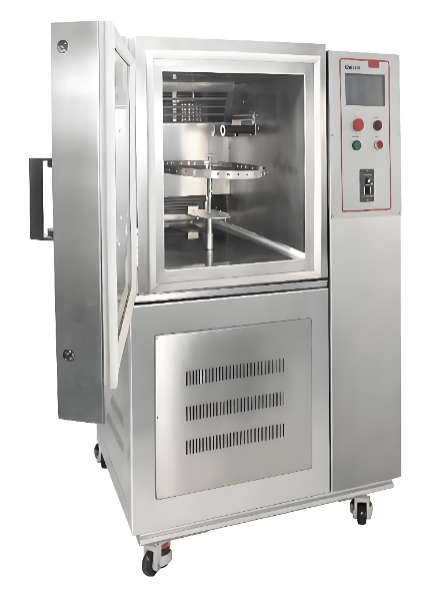
Ozone colour fastness tester Product Description
1. Equipped with a high efficiency ozone generator. It is also equipped with HMOS sensor, ozone concentration of 5ppm, control accuracy of ± 20%, with a durable ccounters. When the tank is full load for test, the ozone concentration can reach 5ppm in about five minutes;
2. Ozone Aging Color Fastness Tester is equipped with a large UV glass observation window, and can acheive closed-loop control of the ozone concentration.The rotating sample holder can hold up to 24 samples. The automatic shut-off featured LED lights improve the observance of the test effect;
3. In order to improve the safety performance of the device, it is equipped with door safety interlock,ozone decomposition catalyst and exhaust design with negative pressure monitoring;
4. The user can conduct on-site calibration each year, and the sensor can also be returned to the factory for calibration. Two calibration standards have NIST traceable calibration. The equipment also has periodic reminders to alert users to replace ozone decomposition catalyst and ozone generator.
Application
The Colour fastness to ozone is mainly used for testing color fastness properties of fabrics exposed to ozone environment; it is the special equipment for testing the fabric colorfastness to ozone.
Standards
AATCC 109-2011 Colorfastness to Ozone in the Atmosphere under Low Humidities.
AATCC 129-2011 Colorfastness To Ozone In The Atmosphere Under High Humidities
ISO 105-G03-1993 Textiles; tests for color fastness; part G03: color fastness to ozone in the atmosphere
GB/T 11039.3-2005 Textiles; tests for color fastness; part 3: color fastness to ozone in the atmosphere
JIS L0890 Test methods for color fastness to ozone
FAQs
1. What is an Ozone Test Chamber used for?
It is used to evaluate the ozone resistance and aging performance of rubber and polymer materials.
2. What materials can be tested?
It is mainly suitable for rubber, elastomers, cables, seals, hoses, and other polymer materials.
3. What does the test evaluate?
It evaluates cracking, aging, and performance changes caused by ozone exposure.
4. Which standards are commonly used?
Common standards include ISO 1431 and ASTM D1149.
5. Can the test conditions be controlled?
Yes, ozone concentration, temperature, and test time can be controlled according to the test requirements.