
Tel:+86-21-6780 0179
Fax:+44(0) 207 398 0999
Email:market@qinsun-lab.com

Shoe Heel Surface Abrasion Sample Grinder
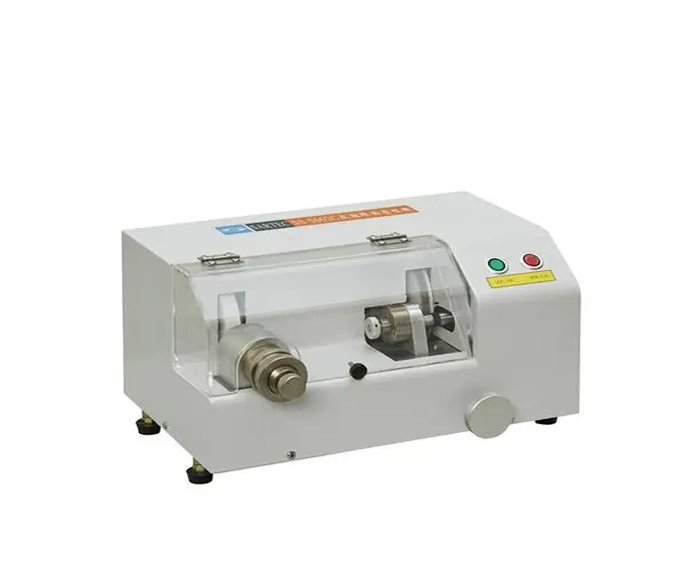
The Shoe Bending Angle Tester is designed to evaluate the rigidity and flexibility of footwear outsoles. By applying a controlled load to the forefoot portion of the shoe, the tester measures the bending angle under specified force and speed. This provides an objective indication of outsole bending performance and helps determine if the sample requires further dynamic flexing tests.
Applications
(1)Testing athletic shoes such as running shoes, basketball shoes, and trainers for forefoot flexibility and bending stiffness.
(2)Evaluation of leather shoes and casual footwear to verify outsole rigidity compliance with design specifications.
(3)Testing work and safety shoes, including steel-toe and composite-toe footwear, for outsole bending performance under controlled loads.
(4)Preliminary assessment of shoe prototypes to determine suitability for dynamic flexing or fatigue testing.
(5)Quality control in footwear manufacturing to ensure consistent outsole stiffness and bending characteristics.
(6)Inspection of children’s shoes for bending flexibility and comfort.
(7)Testing orthopedic and therapeutic shoes to evaluate structural support and bending resistance.
(8)Evaluation of outsole materials such as rubber, EVA, thermoplastic, or PU for bending performance before final assembly.
Standards
(1)GB/T 20991-2007 — Test Methods for Personal Protective Equipment Shoes (8.4.1–4)
(2)QB/T 1002-2015 — Leather Shoes (5.5.4.2)
(3)QB/T 2885-2007 — Footwear Outsole Test Methods for Folding Performance (4.2)
(4)BS EN ISO 17707-2005 — Personal Protective Equipment — Footwear — Outsole Rigidity and Flexing Test
(5)ASTM F2033 — Standard Test Method for Flexing Stiffness of Footwear Soles
(6)EN ISO 20344 — Personal Protective Equipment — Test Methods for Footwear Flexing
(7)DIN 53512 — Testing Methods for Flexing Resistance of Footwear Outsoles
Product Features
(1)Provides precise measurement of outsole bending angle under a controlled load.
(2)Allows preliminary assessment to determine if a shoe is suitable for dynamic flexing or endurance tests.
(3)Adjustable speed and controlled force application for reproducible testing.
(4)Objective and quantitative data display via LED digital readout.
(5)Robust and durable construction for repetitive laboratory and quality control use.
Parameters
| Parameter | Specification |
|---|---|
| Grinding Wheel Drive | High-speed electric motor |
| Grinding Wheel Speed | 2800 r/min |
| Wheel Peripheral Speed | 15–20 m/s |
| Grinding Wheel Diameter | 100–120 mm |
| Power | 120 W |
| Overall Dimensions (L×W×H) | 430 × 260 × 210 mm |
| Sample Diameter After Grinding | 16 ± 0.2 mm |
| Right Bracket Horizontal Travel | 25 mm |
| Right Bracket Forward/Backward Travel | 30 mm |
| Left Bracket Horizontal Travel | 40 mm |
| Power Supply | Single-phase AC 220V, 3A |
Features
(1) Fully Enclosed Design: Ensures safety during operation and minimizes dust exposure.
(2) Precision Grinding: Produces consistent 16 mm test specimens for heel abrasion testing.
(3) Adjustable Brackets: Allows precise positioning of samples in multiple directions.
(4) High-Speed Motor: Ensures smooth, efficient grinding with minimal wear on the wheel.
Test Procedures
(1) Secure the heel sample on the sample holder.
(2) Adjust the right and left brackets to align the sample for grinding.
(3) Turn on the motor and begin grinding.
(4) Move the brackets according to the specified travel distances to achieve uniform material removal.
(5) Measure the sample diameter after grinding to confirm it meets the 16 ± 0.2 mm requirement.
Maintenance Information
(1) Regularly clean the grinding wheel and enclosure to remove debris.
(2) Inspect motor and wheel alignment periodically for consistent performance.
(3) Replace worn grinding wheels to maintain precise sample preparation.
(4) Ensure the power supply is stable and connections are secure.